The purpose of this article is to introduce the types of objects available in the Glossary module.
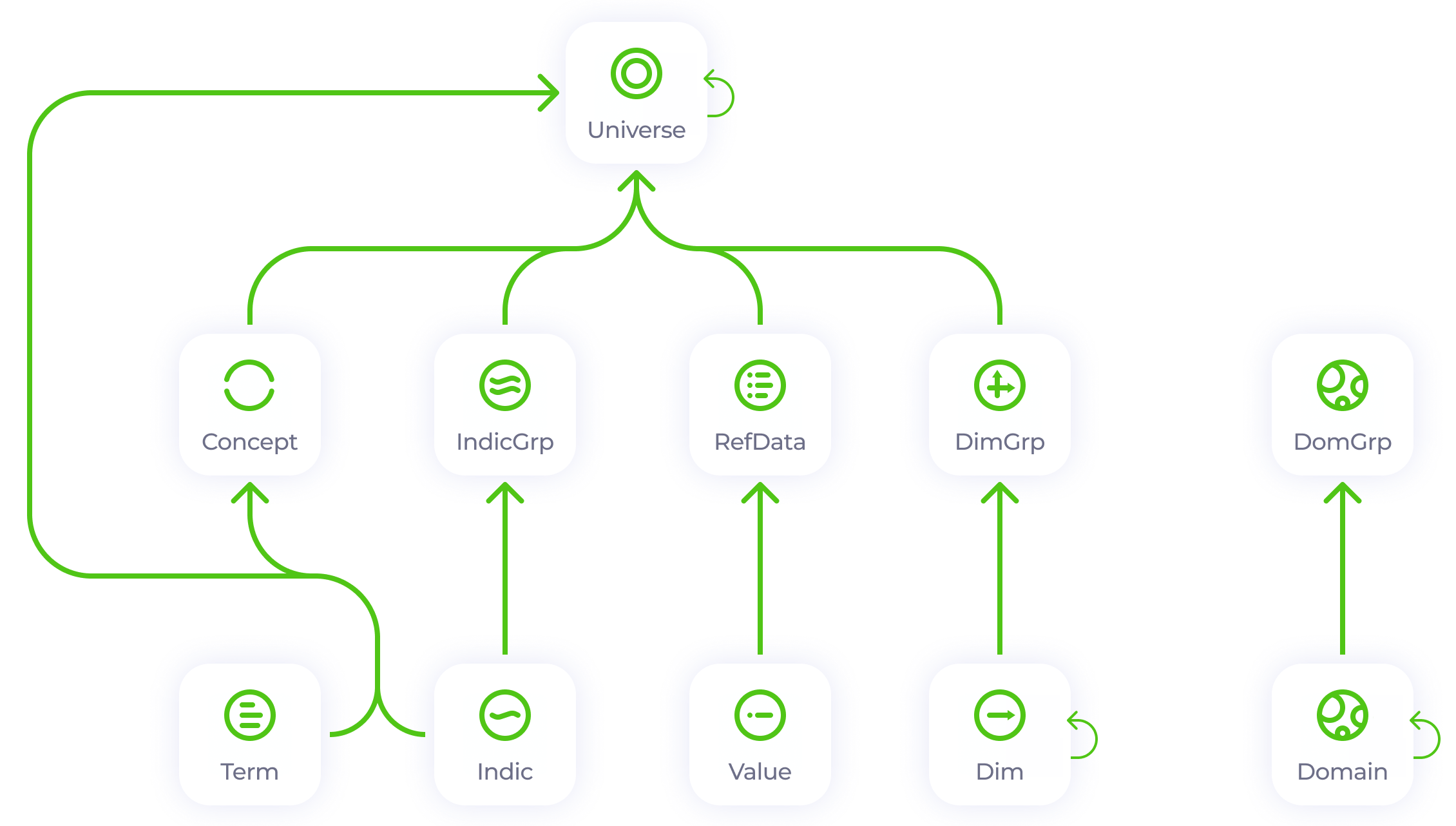
To help you structure your business knowledge, the Glossary module contains a number of object types. Feel free to refer to the chart at the end of this article for a visual representation of these objects hierarchy.
Universe: a set of logically related concepts. Universes are at the top of the Glossary hierarchy, meaning they can contain all Glossary objects, including other universes.
Example : the name of one of your applications.
Concept: a general idea, the abstract representation of an object, or a set of objects with common characteristics.
- Examples : a customer or a product.
- Indicator: the translation of a concept or phenomenon into a number or a signal. An Indicator groupis a set of indicators.
- Example : a "color code" indicator can be nested under a "product descriptor" indicator group.
- Term or Business term: a basic description of reality.
- Example : a "customer ID" or a "product ID".
- Value or Reference data value: the individual value of a nomenclature, a piece of reference data. Multiple Values should be nested under a Reference dataobjet, which is a nomenclature.
- Example: "madam" and "sir" could be two separate values under a "civility" Reference Data.
- Dimension is an axis of analysis, a way you can slice information. Several dimensions can be nested under a Dimension group.
- Examples: Region, Date.
The following Glossary objects are different from the ones above because they are designed to enable a matrix view. After one of these objects has been created, it can be linked to other DataGalaxy objects.
- Domain or Business Domain: an operational process. Several domains can be nested under a Domain Group.
- Examples: HR, finance, sales, after-sales, analytics, UX,...