
[...] However, since data governance is a program dealing in abstracts (data as an asset), it is similar to other programs where tangible results are hard to see, such as marketing or finance. The CEO will acknowledge the need for marketing and certainly the need for a finance area, but a detailed, hard-dollar justification for these areas (as for DG) is usually not sitting in a folder on a desk somewhere. "Data Governance, how to design, deploy and sustain an effective data governance program, John Ladley, 2012
Why build a data catalog? How will it support our data strategy and objectives? What will be the benefits for the users? Why this solution rather than another? How can we make it last? Although an essential step in your data mapping process, building a use case is often underestimated. This article aims to address the importance of identifying and describing the use cases related to data governance
What should be taken into account when creating a use case?
What brings value?
Basically there are two types of governance projects:
- defensive projects: minimizing risks, being in compliance, detecting fraud...
- Offensive projects: improve revenues and profitability, support the creation of new services, improve customer knowledge, etc.
Defensive projects are interesting, because they are easily marketable: a constraint exists (the GDPR), and there is a risk in not applying it. On the contrary, offensive projects, carrot projects, will be less natural. It is necessary to demonstrate how governance is an interesting lever. For example, here are some justifications for indirect gains: How can I monetize data whose quality is not assured? How can I improve the efficiency of my services when a good part of their time is spent cleaning data? Below is a very representative diagram of the cost of non-quality.
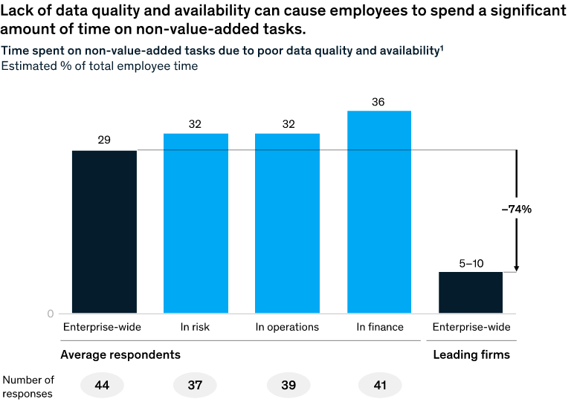
Designing data governance that delivers value, By Bryan Petzold, Matthias Roggendorf, Kayvaun Rowshankish, and Christoph Sporleder, 26 Juin 2020
On the contrary, direct gains are much more complex to demonstrate: how can you prove that adopting good data management practices will improve your business drivers?
Two elements are complementary to demonstrate value creation:
- Analyze the organization's strategy and identify areas where data governance would be most beneficial
- Discuss with managers to identify their needs, the limitations they may have regarding data
Categorize the organization's maturity level
A second element is essential: the organization's maturity. Each level of maturity has its own use cases. Let's take a simple example: a GDPR compliance process. The objective is the same, to control the personal data managed by the organization. But an organization with a high level of maturity may be managing the exchange of sensitive data between systems, whereas a company with a low level of maturity will only be taking an inventory of personal data.
However, as mentioned above, not all organizations have the same level of data management maturity. It is therefore important to assess the level of maturity. (see this article for more details))
The huge advantage of these matrices is that they will allow :
- Make your approach factual
- Easily identify areas for improvement.
- Make it easier to compare organizations with the same needs and constraints
Note : this article is a simplified version of this article, published by Gauthier Coponat on September 17, 2021