
Blink is a core component of the DataGalaxy platform and fully adheres to the fundamental architectural principles that govern our SaaS environment.
The DataGalaxy architecture is built around four core principles:
Security by design – A zero-trust model with encrypted communications, strictly isolated services, and no inbound connectivity required from customer systems.
Full tenant isolation – Each customer environment is logically isolated within the DataGalaxy SaaS infrastructure, ensuring strong separation of data and workloads.
Cloud-agnostic and scalable – The platform is based on a Kubernetes-driven, multi-cloud architecture, deployable on all major cloud providers.
Separation of concerns – Connectors, the SaaS platform, and AI capabilities operate as independent, secured components with clearly defined responsibilities.
Generative AI capabilities in DataGalaxy are delivered through a centralized AI service, accessed exclusively via a secure internal Proxy API. This design ensures that all AI interactions, including those initiated by Blink, pass through a single, controlled entry point, regardless of the underlying AI infrastructure.
The AI compute layer primarily relies on trusted, cloud-based AI services such as AWS Bedrock, Google Vertex AI, or Azure AI Foundry, selected according to scalability, performance, and deployment requirements. When required, DataGalaxy can also run fully self-hosted AI workloads, deployed on its own Kubernetes clusters within controlled cloud environments.
This architecture guarantees consistent levels of data security, tenant isolation, and performance, independently of the AI backend in use.
Models currently used by Blink
Blink relies on a dedicated set of models, each optimized for a specific capability within the conversational workflow:
Qwen3.6 – Primary large language model powering the chatbot experience and natural language understanding.
Qwen3-reranker-0.6B – Reranking model used to refine and prioritize retrieved results based on relevance.
Qwen3-embedding-0.6B – Embedding model used for semantic search and vector-based retrieval.
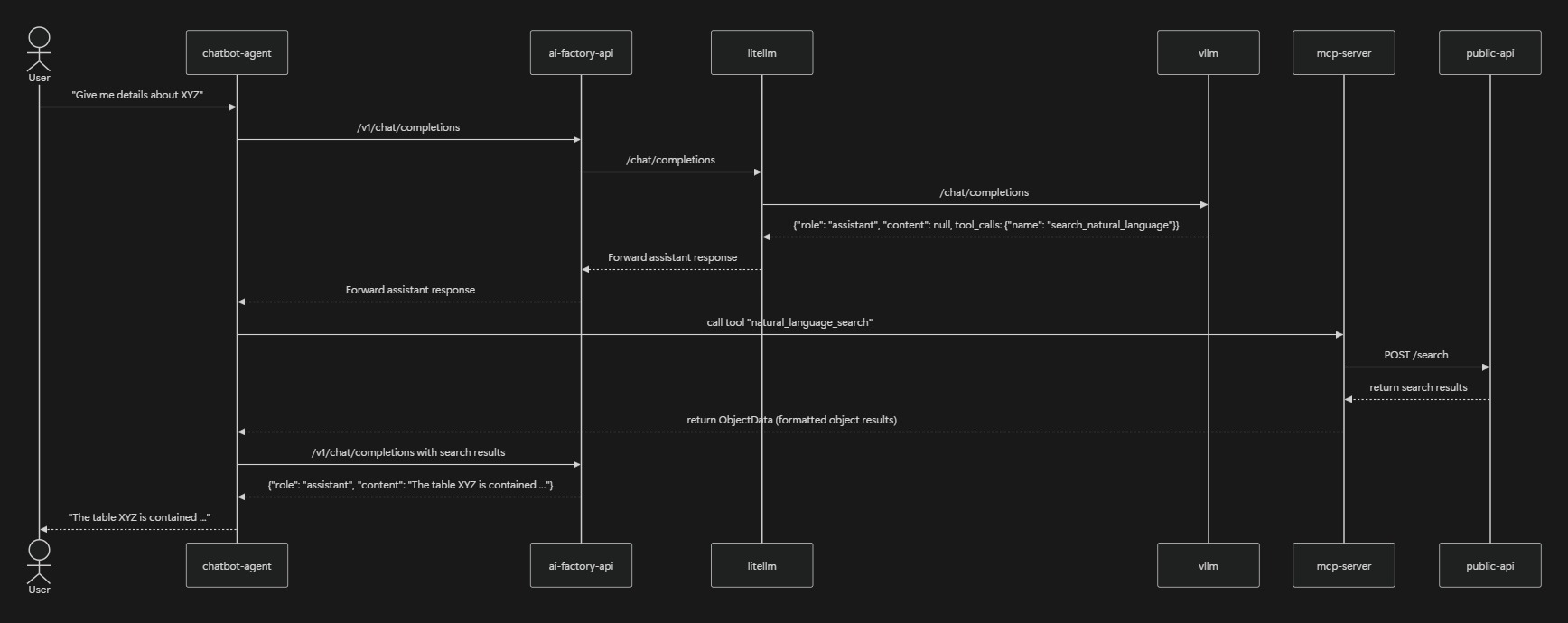
Blink was currently being migrated to an MCP Server-based architecture. In this model, the LLM interprets user requests and dynamically discovers and invokes the appropriate tool or combination of tools required to fulfill the request, further reinforcing modularity, scalability, and control across AI interactions
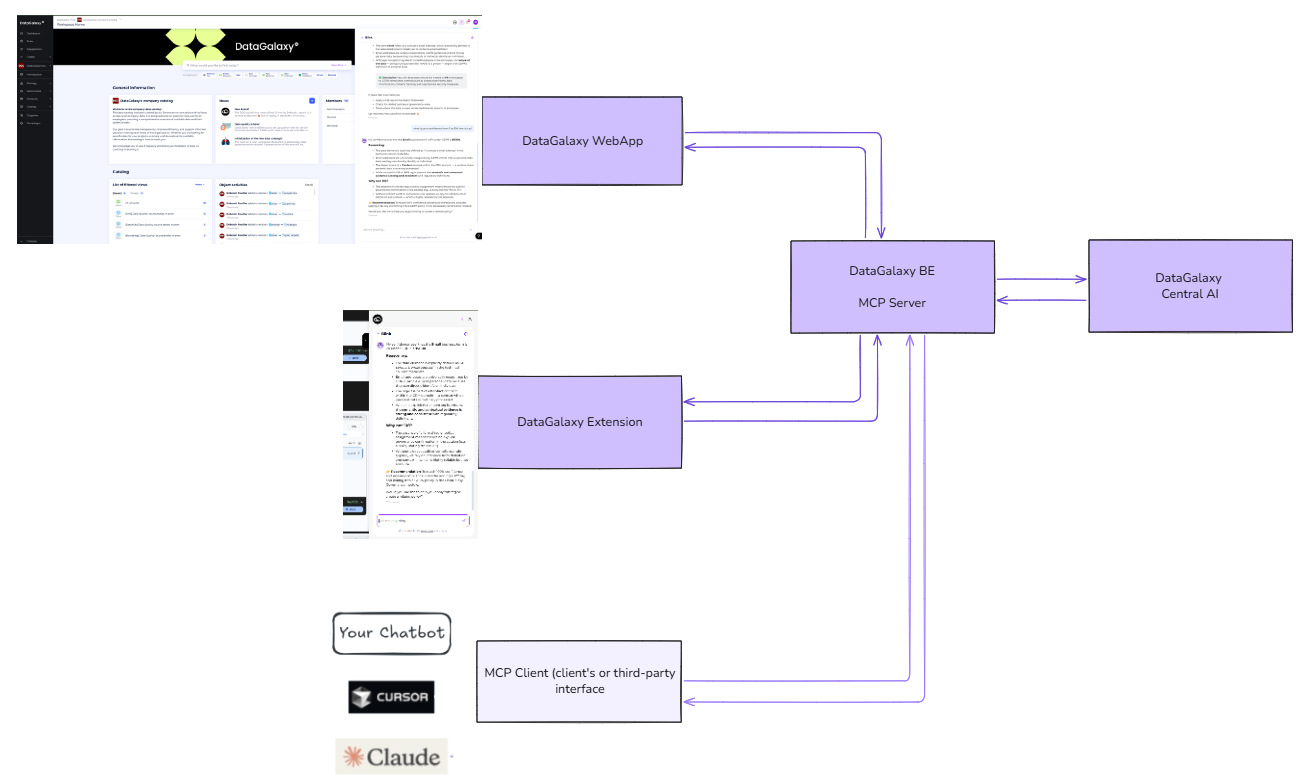
Blink capabilities are exposed through multiple interaction surfaces. Blink is available both directly within the DataGalaxy platform interface and as an extension, while the same underlying capabilities can also be accessed programmatically via an MCP Client connected to the DataGalaxy MCP Server. This ensures functional parity across user interfaces and machine-to-machine integrations, with all interactions relying on the same secured and governed AI infrastructure.
As a part of Blink infrastructure we use Langfuse that allows to manage prompts and to keep the logs for the time period of 30 days.