
Why is this important?
Lineage is a powerful tool for understanding and ownership, for both functional and technical users.
However, when we start to establish the lineage of objects, we are faced with the following question: what granularity should we achieve?
The answer to this question is very important. It depends very strongly on:
- The selected use case, in particular the target audience
- Taking into account constraints: maturity of the organization, maintenance capacities ...
The ability to deliver adequate lineage is however essential for many projects. It allows, in particular, to:
- Understanding data flows and uses
- Identify dependencies
- Simplify user appropriation of data themes
What you need to know before you start
[Basics] Presentation of the impact analysis module
[How to] Use data lineage
Where to start
Lineage construction is therefore a function of several factors. Here are a few:
- The selected use case: undoubtedly the most important. A more BI-oriented project will need a high level of granularity, especially on technical objects, which is not necessarily the case for a governance project which will instead focus on functional modules.
- The maturity of the organization: the more mature the organization is in terms of data management, finer will be the granularity.
- Maintenance capabilities: Very fine granularity implies high construction and maintenance costs. This question is also to be put in relation with maturity: a significant maturity generally allows to have strong maintenance capacities.
Let us take two extremes as an example:
- A complete lineage including detailed field-to-field links with details of the processing units.
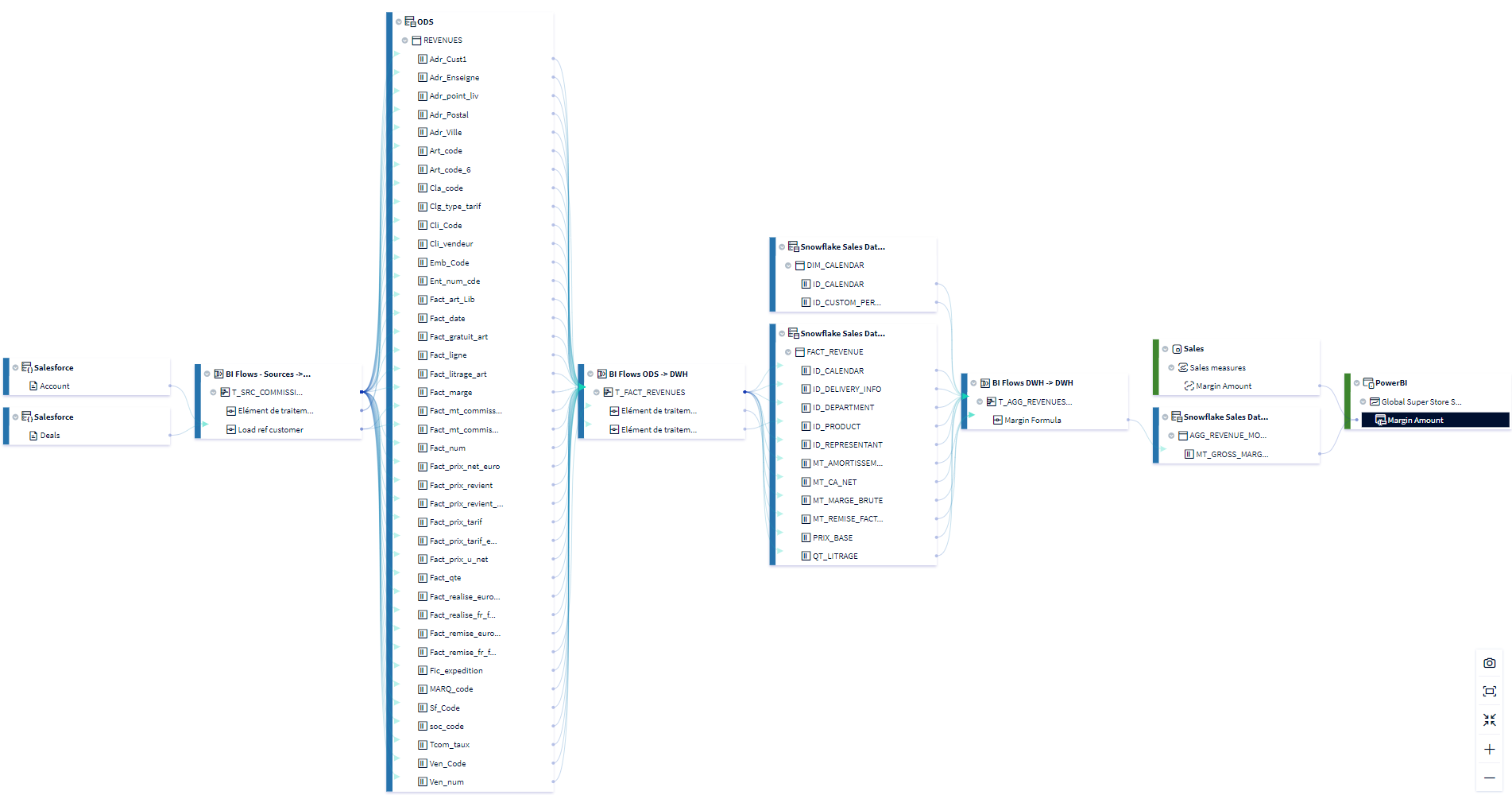
- A simple lineage with links between large entities and functional objects
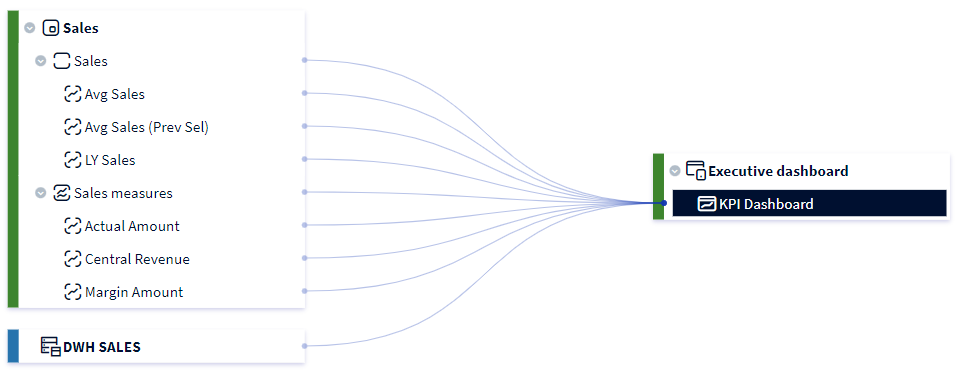
These two lineages naturally meet different needs.
| Complete lineage | Simple lineage |
Need
| Need for details to document / collaborate on work in progress. It allows to
| Need for awareness / acculturation around data. It allows you to answer questions such as:
|
Target audience | Technical profile | Business professional profile |
Positive points |
|
|
Negative points |
|
|
To go further
The reflection on the granularity of the lineage can be deepened with the notion of workspace:
- Workspaces with functional oriented lineages, allowing a better appropriation of the subject
- More complete spaces for technical users