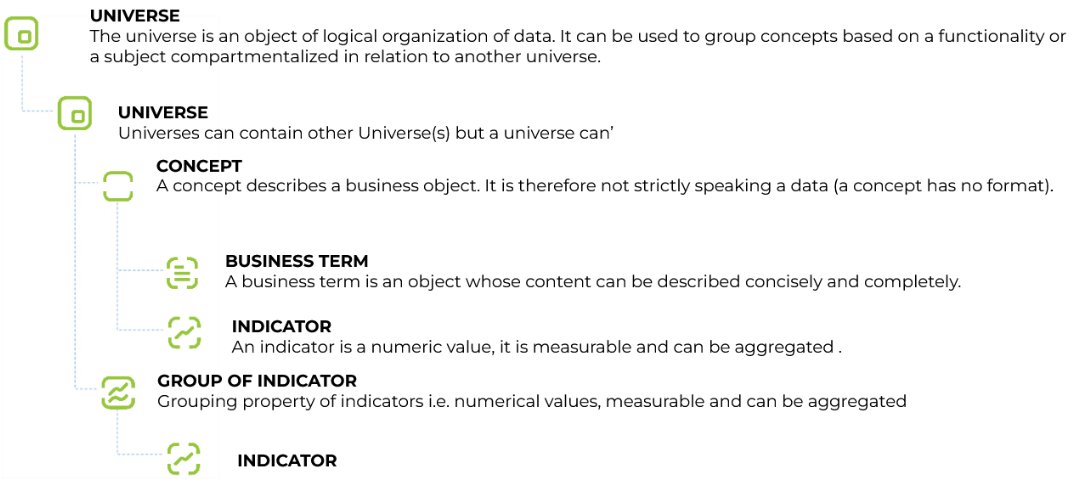
The glossary, like other DataGalaxy modules, is built around objects. Here are some important characteristics of the objects to take into account when structuring the glossary:
- Each object has its own characteristics and capacities of relation.
- Each of these objects must have a unique definition.
- Objects can only have one direct parent. This gives it its context.
- Objects can be organized in a hierarchy thanks to the path. This is why the primary hierarchy of objects (the PATH) is unique: OBJECTS CAN ONLY HAVE ONE PATH
To explain this, let's take the following example: the notion of customer. Depending on whether you are in Marketing or Sales, the definition will be different.
- The customer, from a marketing perspective, can be a prospect
- The customer, from a sales perspective, is a customer who has already been invoiced
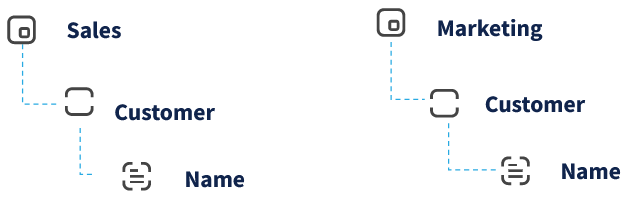
As a reminder, here is a typical example of how the glossary is organized: