
Why is this important?
It is difficult to show data sets which are very often complex in a simple and understandable way: how to highlight a group of data? How to surface important but secondary concepts? How to make this understandable in a simple manner according to its use case and its target audience.
The ability to organize your glossary is therefore a key element to facilitate its understanding. This allows to:
- Facilitate access to data
- Improve user understanding
- Facilitate searches
- Highlight data groupings
What you need to know before you start
How to do it?
In order to classify the glossary, we generally use two objects: the universe and the domain.
The universe is a container which makes it possible to organize its objects in a hierarchical manner, in other words vertically.
It allows to identify and hierarchically list all the data linked to an essential notion.
For example, as part of a marketing data enhancement project, we would like to identify the data available on customers. For this we create a universe called Customers in which we can list our objects. For example, here the business term email address is specific to the universe Customer as a physical person.
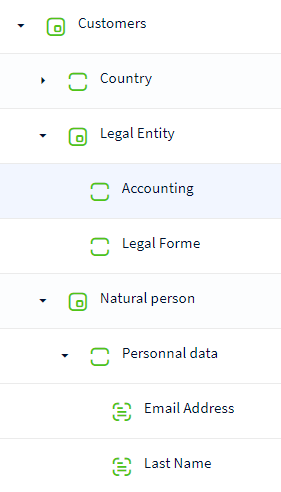
This view allows easy appropriation for all thanks to its graphic aspect. But it may be necessary to link concepts to secondary groupings in order to provide a matrix vision.
Thus, an object could belong to a universe but also to other groupings. This is the goal of the domain object.
We can thus highlight the different data groups to which a notion is attached.
For example, the business term email address available at the level of universe - physical customer is managed by the marketing domain
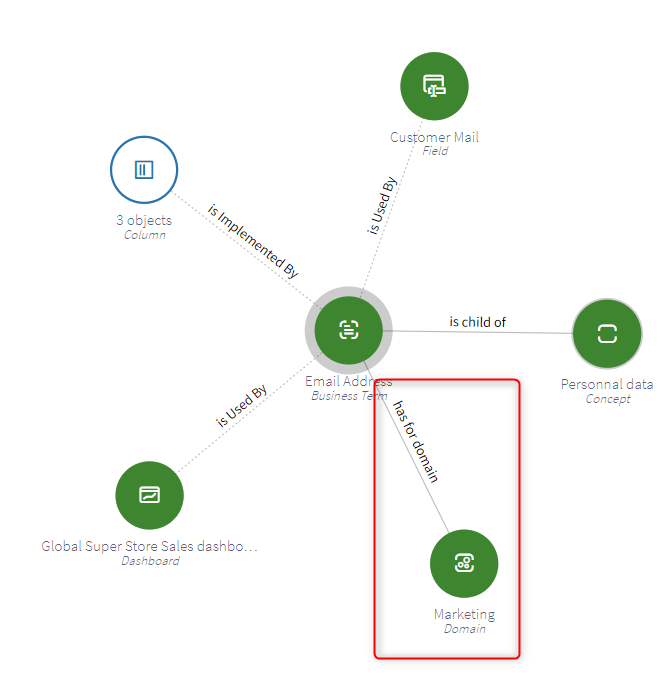
We thus create a particularly powerful matrix view: an object can:
- Have a primary ranking, ranking allowing the creation of data verticals: for example, to represent reference data
- Be linked to different secondary groups: this allows other concepts to be highlighted: data domains, particular data typologies, etc.
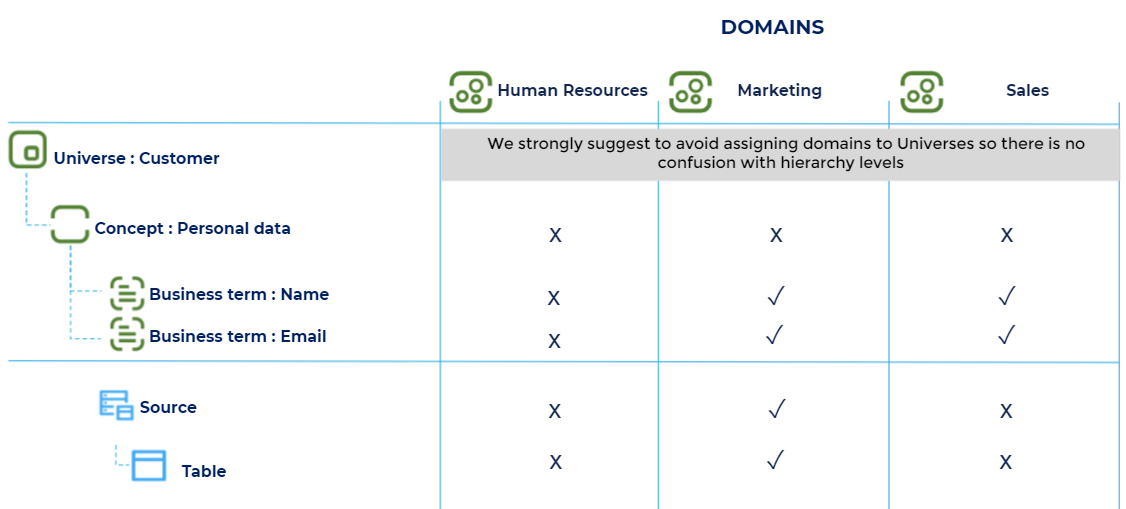
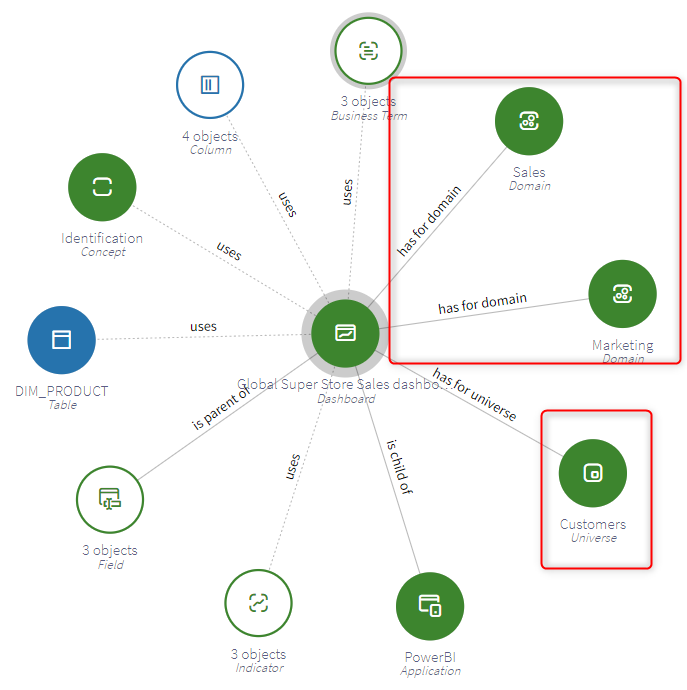
The universes and domains are not limited to the glossary. They allow to structure the objects of the other modules. So, it is possible
- To link dictionary objects, uses or process to a universe
- To link dictionary objects, uses or process to several domains.
For example, here: the global super store sales dashboard has customer as the universe and is linked to two domains: marketing and sales
To go further
The notion of domain is important for modeling. But it also allows to:
- To display membership to a universe or to domains directly on the page of an object: this is the shortcut function. This makes it easier to identify the groups of objects.
- To be used to launch a search: keyboard shortcuts